
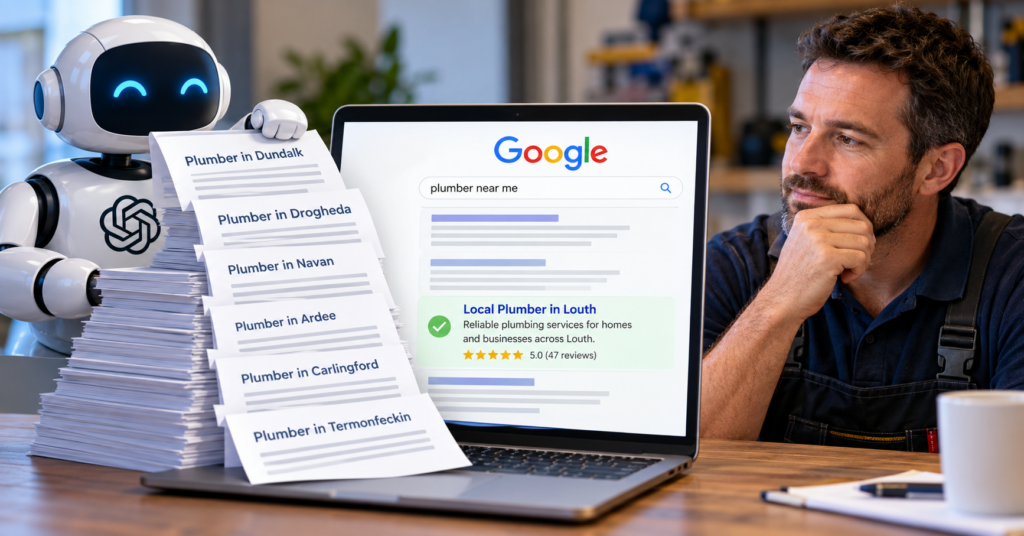
“Give us your website and AI will create the pages that get you found on Google.”
It is an attractive promise, especially for a small business owner who already has enough to do. No keyword research to learn, no evenings spent writing articles, no need to understand SEO. The software finds what people are searching for, creates the content and keeps publishing it.
Some services go even further and suggest that publishing enough AI-generated content can push a business onto page one of Google.
So, does AI-generated content rank on Google?
Yes, it can. But that does not mean that producing more AI content is a reliable SEO strategy.
Google does not automatically reject AI-generated content
Google’s position is not simply “AI content is bad”. Its guidance focuses much more on whether content is useful, original, reliable and created primarily for people rather than for search engines.
That distinction matters. AI can be perfectly useful for researching a subject, organising notes, creating a first draft or improving existing text. The problem starts when the objective becomes producing as many pages as possible because each new page is seen as another chance to rank.
Google explicitly warns against large-scale content production where the main purpose is manipulating search rankings rather than helping users. Its spam policies on scaled content abuse specifically cover producing large amounts of content with generative AI when little or no value is added for users.
100 pages are not automatically better than 10
This is where automated SEO tools can sound very convincing. A plumber, electrician or roofer could suddenly have pages covering dozens of services, customer questions and nearby towns. Technically, creating those pages has become extremely easy.
But a website does not become more useful simply because it has more URLs.
If every page contains roughly the same information with a different town name, slightly different wording or another keyword variation, the site may be bigger without being better. At the extreme, pages created mainly to rank for similar searches and funnel visitors to the same destination can also stray into what Google describes as doorway abuse.
I see a similar issue quite often when looking at small-business websites around Louth. The problem is usually not that the business needs another fifty articles. More often, the important service pages are too vague, the location is unclear, contact details are difficult to find or the website never properly explains what the business actually does.
Publishing another AI article does not fix any of that.
The useful information usually comes from the business itself
Imagine an electrician writing about replacing an old fuse board. AI can easily produce a general explanation of what a consumer unit is, list a few safety benefits and finish by advising the reader to contact a qualified electrician.
There are already thousands of pages like that.
The electrician can add something more useful: what they commonly find in older local homes, how long the work normally takes, whether the power needs to be disconnected, what homeowners should prepare beforehand and which problems can increase the cost.
That is the part AI cannot invent reliably. It comes from actual experience.
AI can help organise that knowledge and turn rough notes into clear website copy. That is a good use of the technology. But the useful part still has to come from somewhere real.
Publishing content is only one part of local SEO
Another weakness in some AI marketing promises is that they make SEO sound like a publishing competition: produce enough articles and eventually Google will send customers.
For a small local business, being found in search depends on much more than article volume. The website needs to clearly explain what the business does and where it works. Important service pages need to be useful. The site needs to work properly on mobile devices. Google needs to be able to crawl it. A Google Business Profile may be extremely important for local searches, and reviews can strongly influence whether someone actually makes contact.
A business can publish five AI-generated articles every week and still have a confusing homepage, a broken enquiry form and service pages that barely explain the service.
That is why I would always fix the core website before worrying about becoming a content machine.
More traffic is not necessarily more business
Traffic numbers can create the same illusion.
Suppose a small heating company in Ireland publishes a broad article about how central heating works. It may eventually attract visitors from the UK, the United States, Australia and other countries. The analytics graph goes up, which looks impressive.
But most of those people cannot hire the company.
A smaller article answering a very specific question from homeowners in the company’s real service area may attract far fewer visitors while being much more valuable commercially.
For most small businesses, the objective is not to become a publisher. It is to help the right potential customer find enough useful information to decide whether to get in touch.
Where AI genuinely helps
None of this means small businesses should avoid AI. Used properly, it can save a lot of time. It is useful for turning notes into drafts, organising frequently asked questions, improving the structure of a service page, spotting gaps in existing content or rewriting technical explanations in clearer language.
The important distinction is simple: AI should help communicate your knowledge, not manufacture the appearance of expertise.
A simple test before publishing AI-generated content
Before publishing an AI-generated page, ask yourself four questions:
- Would I publish this if Google did not exist?
Would the information still genuinely help one of your customers? - Does it contain something specific to my business or experience?
If twenty competitors could publish exactly the same article without changing anything, it probably needs more work. - Can I verify everything it says?
AI can confidently produce incorrect information. The business publishing the page remains responsible for what customers read. - Does this page have a real reason to exist?
Answering a genuine customer question is a good reason. Creating another URL purely to target another keyword variation is much less convincing.
AI is a tool, not an SEO strategy
AI has made content production dramatically faster. That is useful, but speed does not remove the need for judgement.
A good small-business website does not need hundreds of pages simply because software can now create them. It needs clear service pages, useful information, good local relevance and a straightforward way for the right customer to make contact.
Use AI to make the process easier. Just do not confuse the ability to generate content with a guarantee that people will find it, trust it or become customers because of it.
Not sure whether your own website has the basics right before you create more content? Start with the free OTTA Website Health Check. It takes around five minutes and gives you an instant score across five areas: clarity, mobile usability, enquiries, SEO basics, and security & maintenance. No email address is required, and you can download a PDF report with the results and a prioritised list of what may need attention first.
Find our advice useful?
Add OTTA as a preferred source on Google.