
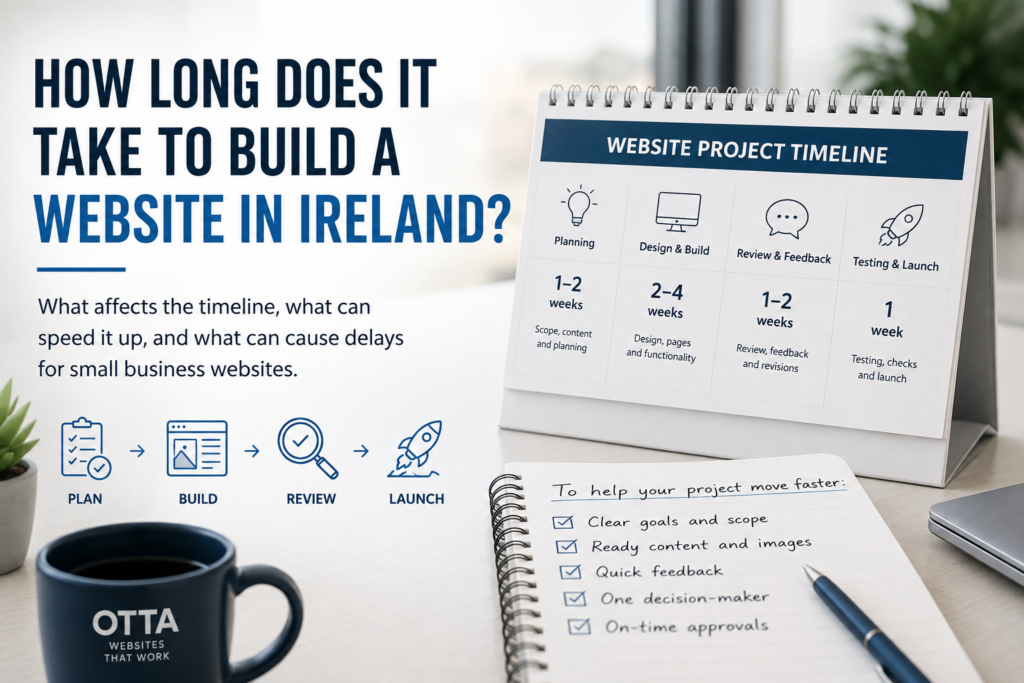
If you are wondering how long does it take to build a website in Ireland, the short answer is that the timeline depends much more on scope, content and decision-making than on the number of days a web designer spends inside WordPress.
A straightforward small business website can often be completed within a few weeks once the requirements are clear and the necessary content is available.
A more complex project can take considerably longer if it includes an online shop, booking system, custom integrations, large amounts of content or several rounds of changes.
The important thing is to understand what actually determines the project timeline before work begins.
How Long Does a Typical Small Business Website Take?
There is no single timeline that applies to every website project.
As a general planning guide, a straightforward small business website may take around 2 to 6 weeks from an agreed project scope to launch.
That does not mean every website should take exactly that long.
A smaller project with finished content, clear requirements and quick feedback may move faster. A larger website with additional functionality, missing content or changing requirements will usually take longer.
The most important factor is not simply the number of pages. It is how much work and how many dependencies exist behind those pages.
What Actually Takes Time During a Website Project?
Building the pages is only one part of a website project.
A typical project may include:
- understanding the business and project goals,
- defining the required pages and functionality,
- collecting or preparing content,
- setting up the website structure,
- building and styling the pages,
- configuring forms and other functionality,
- reviewing the website,
- making agreed revisions,
- testing mobile layouts and links,
- checking technical settings,
- and preparing the website for launch.
The actual WordPress build may therefore be only part of the total calendar time.
1. Defining the Scope Before Work Starts
A website project normally moves faster when the scope is clear before development begins.
That includes deciding:
- which pages are required,
- what each page needs to achieve,
- which functions are needed,
- who is providing the text and images,
- which existing systems must be connected,
- and what is not included in the project.
If those decisions are postponed until development has already started, the project can expand or change direction.
That usually adds more time than spending a little longer defining the requirements at the beginning.
If you are preparing to request a proposal, it helps to know what information to prepare before asking for a website quote in Ireland.
2. Content Is Often the Biggest Delay
One of the most common reasons website projects take longer than expected is missing content.
A designer can build a page layout, but the website still needs real information about the business.
That may include:
- service descriptions,
- business information,
- prices,
- contact details,
- photographs,
- testimonials,
- team information,
- FAQs,
- and legal information.
If the content is ready before the build begins, the project can usually progress much more smoothly.
If every page has to stop while someone writes text, looks for photographs or confirms basic business information, the calendar time quickly increases.
3. Feedback and Decisions Affect the Timeline
A website cannot move from review to launch without decisions.
For a small business, the fastest projects usually have one person who can review the website and approve changes.
If feedback takes several days each time, those delays accumulate.
For example, three review stages with a five-day delay between each one can add two weeks to a project without any additional development work being required.
That is why project timelines should include both the designer’s work and the client’s review time.
4. A Five-Page Website Is Not Always a Simple Website
Page count alone is not a reliable way to estimate how long a website will take.
Two five-page websites can require very different amounts of work.
One might contain:
- Home
- About
- Services
- FAQ
- Contact
with finished text and images already supplied.
Another five-page website might require:
- appointment booking,
- online payments,
- complex quotation forms,
- third-party integrations,
- new website copy,
- image preparation,
- and migration from an existing site.
They may have the same number of visible pages, but they are not the same project.
5. Extra Functionality Usually Adds Time
Additional functionality needs configuration and testing.
Examples include:
- WooCommerce,
- online payment systems,
- appointment booking,
- customer accounts,
- membership areas,
- multilingual websites,
- external software integrations,
- advanced forms,
- and large product catalogues.
The extra time is not only for installing a feature.
It also needs to be configured correctly, tested and checked on the live website.
6. Existing Websites Can Add Migration Work
Replacing an existing website can involve additional tasks that are not required for a completely new business.
For example:
- keeping the old website available during development,
- moving existing content,
- preserving important URLs,
- setting up redirects,
- moving the domain or hosting,
- checking existing email services,
- and making sure the replacement does not break existing customer links.
These tasks are important because launching the new design is only successful if the existing business services continue to work.
7. Testing Should Not Be Skipped to Save a Few Days
A website should not be considered finished simply because the pages look complete.
Before launch, important elements should be checked.
That includes:
- mobile layouts,
- navigation,
- internal links,
- contact forms,
- buttons and calls to action,
- SSL and HTTPS,
- page titles and basic SEO settings,
- images,
- and important business information.
For websites with payments, bookings or other interactive functions, those workflows also need to be tested.
Rushing the launch by removing the testing stage can save a few days but create much larger problems afterwards.
What Can Make a Website Project Faster?
If you want your website project to move efficiently, preparation helps more than pressure.
Before the agreed start date, try to have the following ready:
- your final business name and contact information,
- your logo,
- a clear list of services or products,
- website text or the information needed to create it,
- good-quality photographs where required,
- domain and hosting information,
- details of any existing systems that must be connected,
- and one person who can approve decisions.
Clear requirements at the start can remove days or even weeks of waiting later.
What Usually Makes a Website Project Slower?
The most common delays are usually predictable:
- content arriving late,
- slow feedback,
- changing requirements during development,
- new functionality being added after the project begins,
- missing account or domain access,
- waiting for branding or photography,
- and unclear responsibility for approving changes.
None of these problems is unusual, but they should be considered when agreeing a realistic launch date.
Can a Small Business Website Be Built in One Week?
Sometimes, yes.
A small website with a clearly defined scope, finished content, no unusual functionality and immediate feedback can potentially be completed quickly.
But a one-week deadline should not be treated as the normal expectation for every business website.
If speed means skipping planning, content review or testing, the shorter timeline may not produce the better result.
How Much Does the Website Cost Affect the Timeline?
Price and project duration are related to scope, but they are not the same thing.
A more expensive website may take longer because it includes more pages, content work or functionality.
However, a straightforward project can also take longer simply because content or approvals are delayed.
If you are still planning your budget, see how much a small business website can cost in Ireland.
A Realistic Website Timeline Starts With a Clear Scope
The most useful answer to “how long will my website take?” normally comes after the requirements have been reviewed.
A clear project can be scheduled.
An undefined project cannot.
That is why the pages, functionality, content responsibilities and review process should be agreed before development begins.
For many small businesses, a few well-organised weeks are more realistic and more useful than either an unnecessarily long project or a rushed promise to launch in a few days.
Planning a Small Business Website in Ireland?
OTTA builds clearly scoped WordPress websites for small businesses in Ireland.
The requirements are reviewed before work begins, and the written proposal defines the agreed scope, price and payment schedule.
That also makes it possible to discuss a realistic project timeline before development starts.
Tell OTTA what you need and request a website proposal
Find our advice useful?
Add OTTA as a preferred source on Google.