
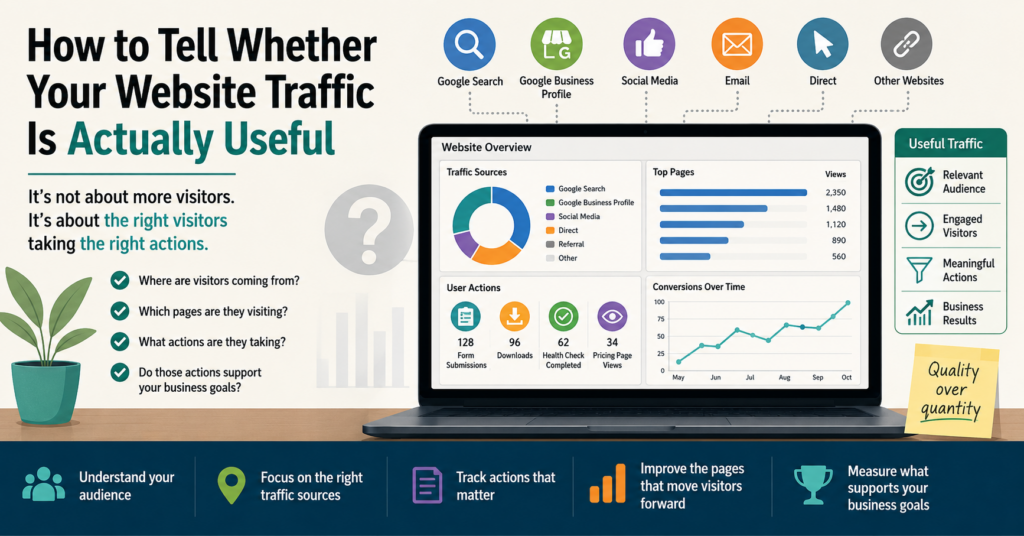
How to tell whether your website traffic is actually useful is a much better question than simply asking whether traffic is going up.
More visitors can look impressive in an analytics dashboard.
But traffic only has value if the people arriving are relevant to the business and can move towards a useful next step.
I would rather have 100 visitors who are genuinely interested in the service than 1,000 visitors who were never likely to become customers.
The useful question is not:
How much traffic did we get?
It is:
What did those visitors actually do?
Start With the Pages People Are Visiting
The first thing I would check is where the traffic is going.
A website may receive a healthy number of visitors while most of them land on pages that have little commercial value.
For example:
- An old blog article
- A general information page
- A page attracting visitors from the wrong country
- A topic that is interesting but unrelated to the services you sell
That traffic is not necessarily worthless.
It may build awareness, help search visibility or introduce people to the business.
But I would not treat every pageview as equally valuable.
For a service business, I would pay particular attention to:
- Homepage visits
- Service pages
- Pricing pages
- Contact pages
- Quote or enquiry pages
- Product pages
Those pages are much closer to a real business outcome.
Look at Where Visitors Come From
The source of traffic can tell you a lot about its likely intent.
Visitors might arrive through:
- Google Search
- Google Business Profile
- Direct visits
- Other websites
Those sources do not all behave in the same way.
Someone searching Google for a specific service may be much closer to making a decision than somebody who casually clicked a social media post.
That does not mean social traffic is bad.
It means I would interpret it differently.
The useful question is whether each traffic source is producing the type of visitor you expected.
If Google Business Profile is an important source for your business, it is worth treating it as part of the wider website journey rather than as a separate channel. I cover that in Google Business Profile or Website: Which Does a Small Business Need?.
Search Traffic Can Be Useful Without Producing an Enquiry Immediately
Google traffic can come from many stages of the customer journey.
Someone searching:
how much does a small business website cost
may only be researching.
Someone searching:
small business web designer near me
may be much closer to choosing a provider.
Both visitors can be useful.
But I would not expect them to behave identically.
This is why looking only at visitor totals can be misleading.
The search that brought the person to the website matters.
Blog Traffic and Service Traffic Serve Different Purposes
A useful blog article can attract visitors who have never heard of the business before.
That is valuable.
But blog traffic usually needs a route into the rest of the website.
If somebody reads an article and then leaves because there is no relevant next step, the article may be generating traffic without contributing much to the business.
I would check whether important articles naturally link to:
- A relevant service
- A useful free tool
- Pricing information
- A contact route
- A related article
That does not mean every blog post needs a sales pitch.
It means the visitor should have somewhere useful to go if they want to continue.
Useful Traffic Should Produce Useful Behaviour
This is where analytics becomes more interesting than simple pageviews.
I would look for actions such as:
- Visiting a service page
- Viewing pricing
- Starting an enquiry
- Submitting a form
- Downloading a useful resource
- Starting a website assessment
- Completing that assessment
- Clicking through to a paid service
Those actions tell you much more about visitor quality than the raw traffic number.
A visitor who reads three relevant pages and starts an enquiry is very different from somebody who opens one blog article and leaves after ten seconds.
If you want to check whether the website itself is functioning properly before interpreting the analytics, see How to Check Whether Your Business Website Is Actually Working.
Track the Journey, Not Just the Destination
Not every useful visitor will become a customer during the first session.
That is why I like tracking the steps before the final enquiry.
For example, a simple funnel might look like:
Article visit → Free Website Health Check → Check completed → PDF downloaded → Paid review viewed
Each step tells you something.
If many people reach the Health Check but nobody starts it, the issue may be the offer or call to action.
If people start but rarely finish, the tool may be too long or unclear.
If they finish and download the report but never look at the paid review, the next step may not feel relevant enough.
That is far more useful than knowing that the page received 200 views.
Conversion Rates Need Context
It is tempting to ask what percentage of website visitors should become enquiries.
I would be careful with one universal benchmark.
The answer depends heavily on:
- The type of business
- The price of the service
- The source of traffic
- The page the visitor lands on
- How ready the visitor is to buy
A visitor reading an educational article and a visitor opening a quote page should not be expected to convert at the same rate.
I would compare like with like rather than trying to force the whole website into one conversion percentage.
Check Whether the Traffic Is Geographically Relevant
This matters especially for local businesses.
A plumber serving one county may receive visitors from another country.
A pet sitter may attract readers from all over the world through a useful article.
The traffic can be real and the content can be successful while still producing no local enquiries.
That is not necessarily a website failure.
It may simply mean the content is reaching a wider audience than the service area.
I would separate:
- Traffic that supports visibility and authority
- Traffic that has realistic commercial potential
Both can have value, but they should not be confused.
Direct Traffic Is Not Always as Clear as It Looks
Analytics often includes a category called direct traffic.
It is easy to assume that every direct visitor typed the website address into the browser.
That is not always the case.
Direct traffic can also include visits where the original source could not be identified.
For example, links from some apps, messages or privacy-focused environments may arrive without useful referral information.
I would therefore treat direct traffic as useful information, but not as a perfect description of visitor behaviour.
Social Media Traffic Needs the Right Expectation
Social media can generate useful awareness without immediately producing enquiries.
Someone may click an article on Facebook because the topic caught their attention.
They may not need the service today.
That does not mean the post failed.
But I would still check whether social visitors do anything useful after arriving.
Do they:
- Read another page?
- Visit a service?
- Use a free tool?
- Return later?
If social consistently produces traffic that never interacts with anything else, I would question whether the content is attracting the right audience.
Do Not Treat Pageviews as the Goal
More pageviews are not automatically better.
A visitor who reads five relevant pages and moves towards a service or enquiry is very different from somebody who clicks around because they cannot find what they need.
I would look for pages that repeatedly appear in useful journeys.
For example, a visitor may arrive through an article, move to a service page, view pricing and then contact the business.
If certain pages repeatedly help visitors move forward, those are the pages I would improve first.
Traffic patterns also change over time, so I would review these journeys periodically rather than assuming the same pages and sources will always matter.
One Relevant Visitor Can Be More Valuable Than Ten Random Ones
This is the part that gets lost when website growth is reduced to traffic charts.
Imagine two months:
Month A: 1,000 visitors, mostly unrelated blog traffic, no enquiries.
Month B: 250 visitors, more service-page visits, several Health Check completions and two serious enquiries.
I would consider Month B much stronger for the business.
The traffic number went down.
The quality went up.
That is why I would avoid making “more visitors every month” the primary goal.
What I Would Check First
If I wanted to understand whether website traffic was actually useful, I would start with these questions:
- Which pages receive the most visitors?
- Where are those visitors coming from?
- Are service and pricing pages being viewed?
- Are blog visitors moving deeper into the website?
- Are visitors taking useful actions?
- Are those actions increasing or decreasing?
- Is the traffic geographically relevant to the business?
- Which pages appear most often before an enquiry or other useful action?
That gives me a much clearer picture than simply looking at total visitors and pageviews.
If You Get Traffic but No Enquiries, Look at the Next Step
If the traffic appears relevant but visitors still do not contact the business, the problem may be further down the journey.
That is where I would look at clarity, trust, contact routes and calls to action.
I cover that in more detail in Website Visitors but No Enquiries: What Small Businesses Should Check.
Check Whether the Website Gives Visitors Somewhere Useful to Go
If you are not sure whether your website makes the next step clear, the Free Website Health Check gives you a structured way to review it.
It takes you through 25 practical questions covering clarity and trust, mobile usability, enquiries, SEO basics, security and maintenance.
You receive an immediate score, category results and a prioritised list of areas worth checking. You can also download the results as a PDF.
Start the Free Website Health Check
When a More Detailed Review Helps
Analytics can tell you what visitors do.
It does not always explain why they do it.
If traffic is arriving but the website still feels ineffective, an outside review can help connect the analytics with what a real visitor sees.
Our Small Website Improvement Review looks at an existing website and identifies practical improvements without automatically assuming that more traffic, more advertising or a complete redesign is the answer.
Final Thoughts
How to tell whether your website traffic is actually useful comes down to behaviour, not volume.
Look at the pages people visit.
Look at where they came from.
Look at what they do next.
And look at whether those actions support the real goals of the business.
Traffic is not the goal. Useful customer behaviour is.
Find our advice useful?
Add OTTA as a preferred source on Google.