
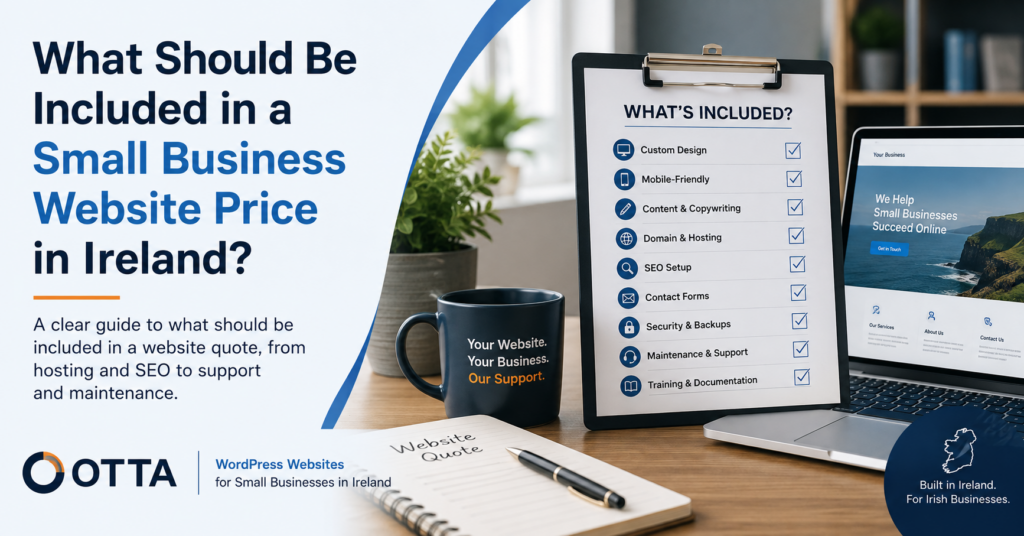
When you compare website quotes for a small business in Ireland, the total price only tells you part of the story. For a small business website price in Ireland, the important question is not only the total cost, but what is actually included.
Two providers may quote a similar amount while including very different levels of work, support and ongoing services.
That is why the better question is not simply:
How much does the website cost?
It is:
What is actually included in the price?
This guide explains the main elements that should usually be considered when reviewing a small business website quote in Ireland.
Start With the Scope of the Website
The first thing to check is the actual scope of the project.
A website quote should make it clear what is being built.
This may include:
- The number of main pages
- Any landing pages
- A blog or news section
- Contact or enquiry forms
- Service pages
- Portfolio or gallery sections
- Booking or ecommerce functionality
- Any integrations with third-party services
A low quote may look attractive until you realise that important pages or features are not included.
If you are still deciding what your website actually needs, our guide on what a small business website actually needs is a useful starting point.
Design and Layout
The quote should explain what level of design work is included.
There is a significant difference between:
- Installing a ready-made template
- Customising an existing theme
- Creating a tailored design around your business
- Building a completely custom website
None of these approaches is automatically wrong.
For many small businesses, a well-configured and carefully customised WordPress website is more than sufficient.
The important thing is to understand what you are paying for.
Mobile-Friendly Design
A modern website should work properly on phones, tablets and desktop computers.
Responsive design should normally be included as standard.
This means the website layout should adapt to different screen sizes without requiring visitors to zoom, scroll sideways or struggle with buttons and menus.
If mobile optimisation is being presented as an expensive optional extra, ask why.
Content and Copywriting
One of the biggest differences between website quotes is often content.
You need to establish who is responsible for:
- Writing the page content
- Editing existing text
- Choosing or providing images
- Formatting content
- Creating service descriptions
- Writing calls to action
Some website designers expect the customer to provide all finished text and images.
Others include basic content assistance or professional copywriting.
Neither model is necessarily better, but it should be clear before the project begins.
Domain Name
Your domain name is the address people use to reach your website.
For example:
yourbusiness.ie
A website quote should make clear whether domain registration is included and who owns the domain.
Ideally, the domain should be registered in your name or under an account that you control.
You should also know the annual renewal cost.
Website Hosting
Every website needs hosting.
Hosting is the service that stores the website and makes it available online.
Before accepting a website quote, ask:
- Is hosting included?
- For how long?
- What is the annual renewal price?
- Who manages the hosting account?
- Can the website be moved elsewhere later?
Cheap hosting can sometimes result in slow performance or poor support, while expensive hosting is not automatically better.
The important thing is that the hosting is appropriate for the website and that the ongoing cost is transparent.
SSL Certificate
A modern business website should use HTTPS.
This requires an SSL certificate.
In many hosting packages, SSL is available at no additional cost.
If a provider charges separately for a basic SSL certificate, ask exactly what is being provided.
Contact and Enquiry Forms
For many small businesses, the main purpose of the website is to generate enquiries.
Contact forms should therefore be included in the project where required.
The quote should specify:
- How many forms are included
- Where enquiries are sent
- Whether spam protection is configured
- Whether submissions are stored
- Whether confirmation emails are included
More advanced forms, such as detailed quote requests or multi-step enquiry forms, may reasonably cost more.
Basic SEO Setup
A website does not automatically rank well in Google simply because it exists.
However, a professionally built website should normally include a basic technical SEO setup.
This may include:
- Search-friendly page titles
- Meta descriptions
- Correct heading structure
- Clean URLs
- Image alt text
- XML sitemap configuration
- Search engine indexing settings
- Google Search Console setup
This is different from an ongoing SEO campaign.
Long-term SEO work, content creation and link building are normally separate services.
Analytics and Search Tracking
You should be able to see whether people are actually visiting your website.
Depending on the project, your provider may configure:
- Website analytics
- Google Search Console
- Conversion or enquiry tracking
- Cookie consent tools where required
These tools are useful because they allow you to make future decisions based on actual visitor data rather than guesses.
Performance Optimisation
Website speed matters for both visitors and search engines.
A basic performance setup may include:
- Image optimisation
- Caching
- Minimising unnecessary plugins
- Appropriate hosting configuration
- Testing the site on mobile devices
You do not necessarily need an expensive performance package for a small business website, but the site should not be unnecessarily slow.
Security
Basic website security should also be considered.
For a WordPress website, this may include:
- Secure administrator accounts
- Strong authentication
- Software updates
- Spam protection
- Backups
- Basic security monitoring
No website can be guaranteed to be completely secure, but good configuration reduces unnecessary risk.
Backups
Before the website goes live, establish how backups will be handled.
You should know:
- How often backups are created
- Where they are stored
- How long they are retained
- Who is responsible for restoring the website if something goes wrong
A backup that has never been tested or cannot easily be restored is of limited value.
Website Maintenance
One of the most important things to clarify is what happens after launch.
WordPress websites require ongoing software updates and maintenance.
This may include:
- WordPress core updates
- Theme updates
- Plugin updates
- Security checks
- Backups
- Compatibility checks
- Minor content changes
Some providers include a maintenance period in the initial website price.
Others offer a separate monthly or annual care plan.
You can read more about this in our guide to small business website maintenance.
Training and Documentation
If you want to update the website yourself, ask whether training or documentation is included.
This may cover tasks such as:
- Editing text
- Changing images
- Adding blog posts
- Managing contact forms
- Updating opening hours or service information
For many small business owners, basic training can make the website much more useful after launch.
Support After Launch
A website project should also make clear what happens if you need help after the site goes live.
Ask:
- Is post-launch support included?
- For how long?
- How do I request help?
- What type of support is included?
- How are additional changes charged?
This is particularly important if you do not want to manage technical problems yourself.
Ownership and Access
You should understand who owns and controls the important parts of your website.
This includes:
- The domain name
- The WordPress administrator account
- The hosting account
- Website files
- The database
- Analytics accounts
- Search Console access
Ideally, you should not become permanently dependent on one provider simply because they control all of the accounts.
What Is Usually Not Included?
Even a good website quote may not include everything.
Services that are often charged separately include:
- Professional photography
- Logo design
- Professional copywriting
- Advanced SEO campaigns
- Paid advertising
- Complex ecommerce functionality
- Custom integrations
- Large amounts of ongoing content work
- Major changes after launch
These are not necessarily hidden costs.
The important thing is that they are clearly identified before you agree to the project.
How to Compare a Small Business Website Price in Ireland
If one provider quotes €900 and another quotes €1,500, the cheaper quote is not automatically better value.
The €1,500 quote might include hosting, backups, forms, SEO setup, analytics, training and post-launch support.
The €900 quote might include only the basic website build.
This is why comparing website prices without comparing the scope can be misleading.
If you want a broader overview of typical pricing, read our guide on how much a small business website costs in Ireland.
You can also read our guide on how much a small business should spend on a website in Ireland.
Planning a Small Business Website?
At OTTA, we build practical WordPress websites for small businesses in Ireland.
We focus on clear project scope, straightforward pricing and making sure you understand what is included before the work begins.
You can see our current website options on the OTTA services page.
If you already know what you need, you can also send us the details through our website project enquiry form.
Find our advice useful?
Add OTTA as a preferred source on Google.