
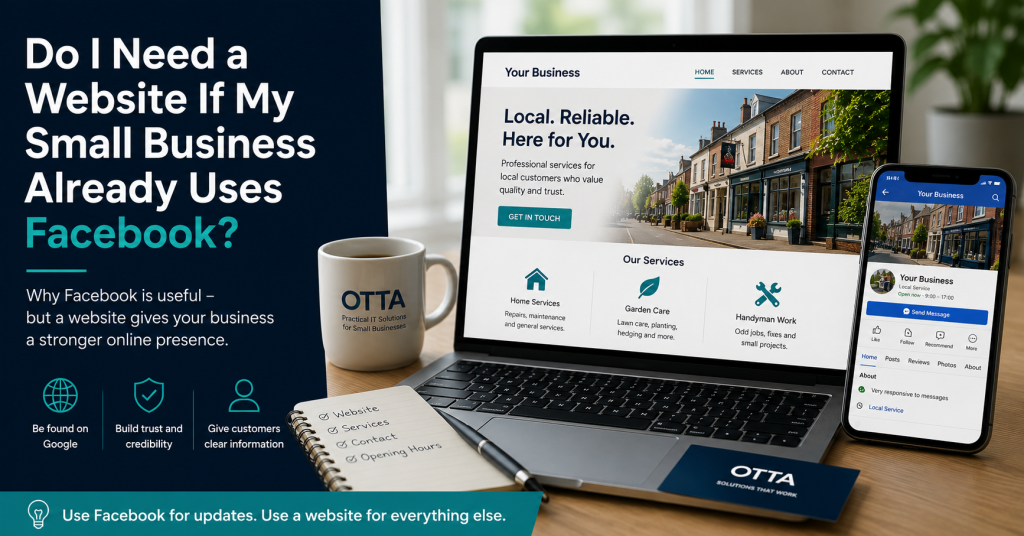
A small business website can still be useful even if your business already uses Facebook. Facebook can be a practical communication channel, but it does not give you the same control as your own website.
You can publish updates, show photos, answer messages and let customers see that the business is active. Setting up a page is quick, and most customers already know how to use the platform.
So why would you also need a website?
The answer is not that every business needs a large or complicated website. In many cases, a small, clearly structured website is enough.
The main difference is simple:
Facebook is a useful communication channel. A website is your own permanent business base.
Facebook Can Be a Good Starting Point
A Facebook page can work well for a new or very small business.
It allows you to:
- publish recent photos and updates,
- communicate with existing customers,
- receive messages,
- collect reviews,
- announce opening hours or availability,
- and build a local following.
For businesses that depend heavily on recommendations and repeat customers, Facebook may generate a reasonable amount of work.
The problem is not that Facebook is useless. The problem is relying on it as the only place where customers can find information about your business.
Not Every Customer Uses Facebook
Some customers do not have a Facebook account. Others rarely use the platform or prefer not to log in simply to check a business.
A potential customer may only want to know:
- what services you provide,
- where you are based,
- how much something approximately costs,
- whether the business appears legitimate,
- and how to contact you.
A simple website can answer these questions without requiring the customer to use a social media platform.
It also gives you one clear link that you can place on business cards, invoices, email signatures, Google Business Profile listings and social media accounts.
Customers Often Start With Google
When someone needs a local electrician, dog walker, cleaner, gardener, photographer or other practical service, they may search directly on Google.
They may search for phrases such as:
- “dog walker in Dundalk”
- “small business website Ireland”
- “local electrician near me”
- “pet sitter prices”
- “garden maintenance in Louth”
A Facebook page may appear in some search results, but it usually gives you less control over what the customer sees.
With your own website, you can create a dedicated page for each important service. You can clearly explain what you offer, where you work and how customers should contact you.
This gives search engines more useful information about your business and gives potential customers a better page to visit.
You Do Not Fully Control Your Facebook Page
Your Facebook page belongs to your business, but the platform itself belongs to Meta.
Facebook controls:
- how your page is displayed,
- which posts people see,
- what features are available,
- how customers must log in or interact,
- and whether the platform changes its rules or layout.
This does not mean that your Facebook page will suddenly disappear. It means that it should not be the only place where your business exists online.
Your own website gives you more control over:
- your content,
- your branding,
- your service descriptions,
- your contact process,
- and the order in which customers receive information.
You can still use Facebook, but it becomes one way of directing people towards your business rather than the entire foundation of your online presence.
A Small Business Website Does Not Need to Be Complicated
Many small-business owners avoid websites because they imagine a large project with dozens of pages, online payments, customer accounts and ongoing technical work.
Most local businesses do not need that.
A practical small-business website may only need:
- A homepageA short explanation of who you are, what you do and where you operate.
- A services pageA clear list of the services you provide, including any important limits or service areas.
- An about pageBasic information about the business, your experience and why customers can trust you.
- A contact pageA simple way for customers to make an enquiry.
- Essential legal and privacy informationThe appropriate pages depend on the business and how the website collects information.
Some businesses may also benefit from a price page, frequently asked questions, customer reviews or a small blog.
The goal is not to add as many pages as possible. The goal is to answer the customer’s main questions clearly.
Your Website Can Reduce Repetitive Questions
A good website is not only a marketing tool. It can also save time.
Small businesses often receive the same questions repeatedly:
- What areas do you cover?
- What are your prices?
- Do you work at weekends?
- What information do you need before giving a quote?
- Do customers need to provide materials?
- How quickly can the work be completed?
When this information is clearly available on your website, customers can understand the basic service before contacting you.
This can lead to better enquiries because customers already know what you offer and whether the service is suitable for them.
It can also help discourage enquiries for work that you do not provide.
Facebook and a Website Work Better Together
You do not need to choose between Facebook and a website.
They serve different purposes.
Facebook works well for:
- recent updates,
- informal photos,
- announcements,
- community interaction,
- and staying visible to existing followers.
A website works well for:
- permanent service information,
- Google searches,
- professional credibility,
- detailed explanations,
- and converting visitors into enquiries.
A practical setup is to publish regular updates on Facebook while using the website as the main source of accurate business information.
For example, a Facebook post can show a recently completed project and then link to the relevant service page on your website.
The social media post creates interest. The website provides the full explanation.
When Facebook Alone May Be Enough
There are situations where a website may not yet be necessary.
Facebook alone may be sufficient when:
- the business is only a temporary experiment,
- you are not currently looking for new customers,
- all work comes through a small group of existing clients,
- the service is only available occasionally,
- or you are still deciding whether to continue the business.
Even then, it is worth considering what happens when someone recommends your business.
Will the potential customer find clear and current information?
Will they understand what you offer?
Will they know how to contact you?
If the answer is no, a small website may already be useful.
Signs That Your Business Is Ready for a Website
A website is worth considering when:
- customers regularly ask where they can find more information,
- you repeatedly send the same service details by message,
- you want to appear more established,
- you want customers to find you through Google,
- your Facebook page is difficult to navigate,
- important information is spread across old posts,
- or you want a more structured enquiry process.
You do not need to wait until the business becomes large.
In fact, a small website is often easiest to build when the service offering is still clear and manageable.
What Should You Prepare Before Building a Website?
Before starting a website project, try to collect the following information:
- your business name,
- the main services you provide,
- your service area,
- your preferred contact method,
- your opening or working hours,
- any prices you want to publish,
- several useful photos,
- your logo, if you have one,
- and the most common questions customers ask.
Do not worry if everything is not perfect.
A practical website can start with the essential information and be improved later.
Clear and accurate content is more important than complicated design.
The Website Should Match the Actual Business
A website should not make a small business look artificially large.
Customers usually value clarity and honesty more than exaggerated marketing language.
The website should accurately explain:
- what you do,
- what you do not do,
- who the service is suitable for,
- where you operate,
- and what the customer should do next.
This is particularly important for small local businesses and independent service providers.
A clear, straightforward website can feel far more trustworthy than a large site filled with vague claims.
Final Answer: Facebook Is Useful, but It Is Not a Complete Replacement
A Facebook page can remain an important part of your business.
However, it works best alongside a website rather than as a complete replacement for one.
Your website gives customers a stable place to find your services, contact details and essential business information. Facebook can then be used for updates, photos and ongoing communication.
You do not need a large website.
You need a website that clearly answers the customer’s questions and makes the next step easy.
Need a Simple Website for Your Small Business?
OTTA creates practical, clearly scoped websites for small businesses, independent service providers and local organisations.
The focus is on essential pages, clear information and a straightforward enquiry process rather than unnecessary complexity.
Learn more about OTTA’s small website projects or send a project enquiry to describe what your business needs.
Find our advice useful?
Add OTTA as a preferred source on Google.