
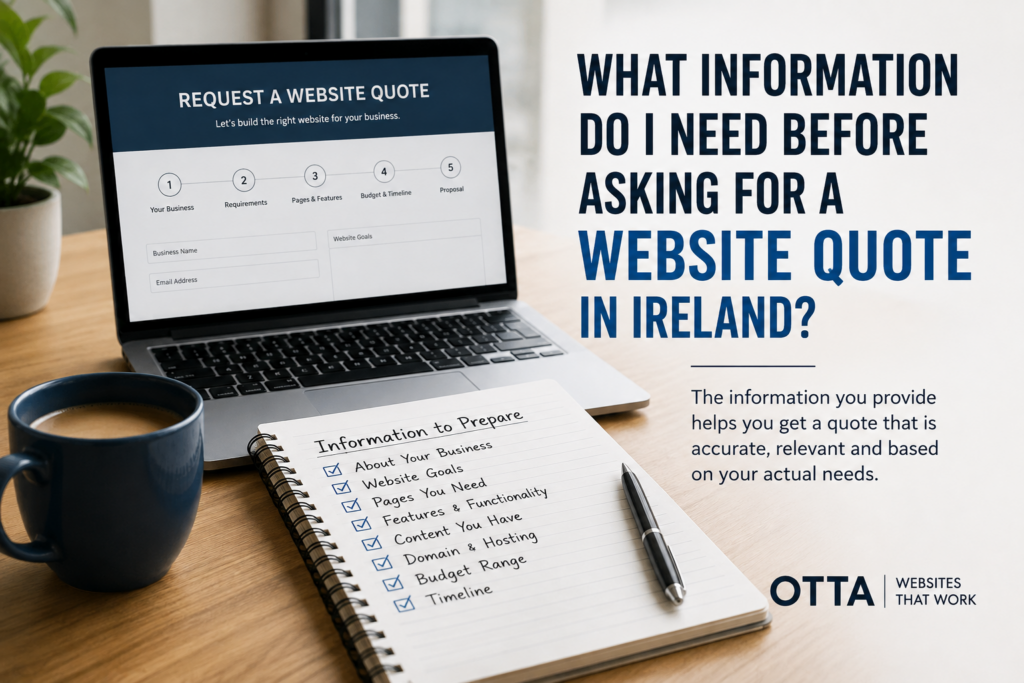
If you are looking for a website quote in Ireland, you do not need to have every detail worked out before contacting a web designer.
But providing a few key pieces of information can make the initial discussion much more useful and help you receive a website quote based on your actual requirements rather than guesswork.
For a small business website, the most useful information usually falls into a few practical areas: what your business does, what the website needs to achieve, which pages and functions you need, what content you already have, and your expected budget and timeframe.
Here is what to prepare before asking for a website quote in Ireland.
1. Explain What Your Business Does
Start with a short description of the business.
You do not need to write a full company history. A few clear sentences are normally enough.
Useful information includes:
- what products or services you provide,
- who your typical customers are,
- where you operate,
- whether customers visit a physical location,
- and how customers currently find or contact you.
For example:
We are a plumbing business serving Dundalk and surrounding areas. Most of our work comes through referrals and Facebook, and we want a website that explains our services and makes it easier for customers to request a quote.
That gives a web designer much more useful context than simply saying, “I need a five-page website.”
2. Explain What You Want the Website to Achieve
A website should have a practical purpose.
For one business, the main goal may be generating enquiries. Another may need customers to view services and prices. A shop may need online sales, while a restaurant may primarily need opening hours, menus and contact details.
Think about what you would like a visitor to do after arriving on the website.
That might be:
- call your business,
- send an enquiry,
- request a quote,
- make a booking,
- visit your premises,
- view your services,
- buy a product,
- or simply understand your business before making contact.
This helps determine the structure of the website and which features are actually necessary.
3. List the Pages You Think You Need
You do not need to design the entire website structure yourself.
However, a rough idea of the information you want to publish makes it much easier to estimate the project.
A straightforward small business website might include:
- Home
- About
- Services
- Individual service pages
- Contact
- Frequently Asked Questions
- Privacy and other required information
Some businesses may also need:
- Portfolio or project pages
- Testimonials
- Price information
- Location pages
- Blog or news section
- Online shop
- Booking information
If you are unsure, say so. A good proposal should help define the appropriate structure rather than simply adding pages unnecessarily.
4. Mention Any Special Functions You Need
Functionality can significantly affect the scope and cost of a website.
If you already know that you need a particular feature, mention it at the beginning.
Examples include:
- contact or quotation forms,
- appointment booking,
- WooCommerce,
- online payments,
- customer accounts,
- downloadable documents,
- newsletter signup,
- maps,
- galleries,
- integrations with an existing service,
- or multilingual content.
You do not need to know which WordPress plugin or technical system should be used.
Describe what you need the visitor to be able to do. The technical solution can then be assessed separately.
5. Say Whether You Already Have a Website
If you already have a website, provide the address.
Also explain what you want to keep and what you want to change.
For example:
- the design feels outdated,
- the website is difficult to use on mobile,
- services have changed,
- information is no longer accurate,
- enquiries are difficult to submit,
- or the existing site is difficult to maintain.
An existing website can also contain useful material such as text, photographs, service descriptions and company information that may be suitable for the new project.
6. Explain What Content You Already Have
Content is one of the biggest practical factors in a website project.
Before requesting a quote, consider what you already have available.
This may include:
- logo,
- business photographs,
- staff or team photographs,
- service descriptions,
- product information,
- prices,
- testimonials,
- contact information,
- company details,
- existing website text.
Also be clear about what is missing.
If you need help editing existing text or writing completely new website copy, that work should be included in the project scope rather than discovered halfway through the build.
7. Mention Your Domain and Hosting Situation
If you already own a domain name, provide it.
If you already have hosting, mention that as well.
You do not need to send passwords or account access when asking for an initial quote.
At this stage, it is normally enough to explain:
- whether you already own the domain,
- where the current website is hosted if known,
- whether business email uses the same domain,
- and whether you want to keep the existing setup.
This can reveal technical work that may need to be included in the project, such as moving a website, changing DNS settings or connecting a new site to an existing domain.
8. Give a Realistic Budget Range
Many business owners are hesitant to mention a budget because they are worried that the quote will simply expand to match it.
But a realistic budget range can actually prevent both sides from wasting time.
A €1,500 brochure website and a €6,000 website with custom functionality are very different projects.
Knowing roughly what the business is prepared to invest allows the proposal to focus on a realistic solution.
If you genuinely do not know what websites normally cost, that is also fine. You can first review typical website costs in Ireland and then discuss which level of project is appropriate.
9. Mention Any Important Deadline
If the website needs to be ready for a specific event, opening date or business launch, say so when requesting the quote.
For example:
- opening a new business,
- launching a new service,
- replacing a website before an advertising campaign,
- or preparing for a seasonal period.
A deadline does not automatically mean the project can be completed by that date, but it allows the designer to assess availability and identify any dependencies early.
If there is no fixed deadline, say that as well.
A realistic schedule is usually easier to agree when both sides know from the beginning whether timing is flexible.
10. Mention Anything That Could Affect the Project
Finally, include anything unusual that may affect the work.
That could include:
- an existing online shop,
- hundreds of products,
- membership functionality,
- complex forms,
- third-party integrations,
- multiple business locations,
- large amounts of existing content,
- special accessibility requirements,
- or an existing website that must remain online during the rebuild.
It is better to mention these requirements before the quote is prepared than discover them after the project has started.
You Do Not Need a Complete Technical Specification
A small business owner should not need to become a web developer before requesting a website proposal.
You do not need to decide which plugins should be installed, how the database should work or which hosting configuration is required.
What you should be able to explain is:
- what your business does,
- what you want the website to achieve,
- what information it needs to contain,
- what functions you know you require,
- what content and accounts you already have,
- your approximate budget,
- and whether there is an important deadline.
From there, the technical scope can be defined properly.
A Better Quote Starts With Better Information
Website quotes are much more useful when they are based on a defined project rather than an assumed number of pages.
Two businesses may both ask for a “small five-page website” while requiring completely different amounts of work.
One may already have finished text, photographs and a domain.
The other may need new copy, image preparation, email configuration, booking functionality and migration from an existing website.
Those are not the same project.
Providing the right information at the beginning makes it easier to compare proposals, understand what is included and reduce unexpected changes later.
Planning a Small Business Website in Ireland?
OTTA builds clearly scoped WordPress websites for small businesses in Ireland.
Before work begins, the project is reviewed and a written proposal defines the agreed pages, functionality, responsibilities, price, payment schedule and any work that is outside the scope.
You do not need to prepare a technical specification.
Tell OTTA about your business, what you need the website to do, the content you already have and any particular requirements.
Request a website proposal from OTTA
Find our advice useful?
Add OTTA as a preferred source on Google.