
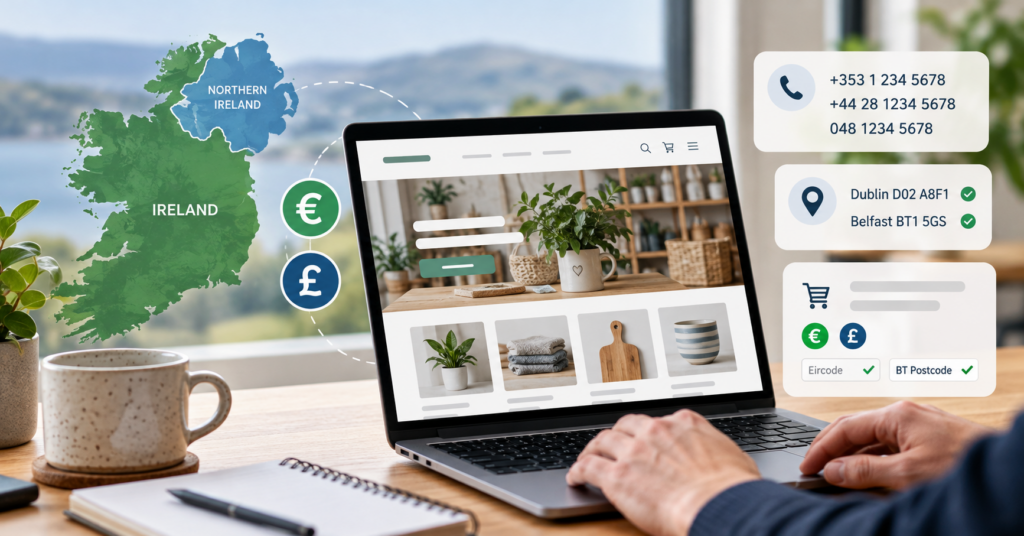
I live in Dundalk, a short drive from the border. Businesses here can have customers from Newry, Armagh or Crossmaglen as well as Co. Louth. The same goes the other way round, and for towns along the border from Derry to Carlingford.
It’s easy to build a business website without thinking much about that border. Prices in one currency, a phone number in one format, a checkout that only knows one country. Nothing is necessarily technically broken. But a customer from the other side may encounter small obstacles at every step, and some will leave without telling you why.
These are the things I’d check on a website that needs to work for customers in both Ireland and Northern Ireland.
Prices: Euro, Sterling or Both?
A customer in Newry who sees €85 may need to work out roughly what that means in sterling. If they pay by card, their bank may also charge a fee for a foreign-currency transaction, depending on their account.
Neither is necessarily a deal-breaker, but making the price easier to understand can remove some uncertainty.
There are three workable approaches:
- Show both, charge one. Display a price such as “€85 (approximately £72)” with a clear note that payment is taken in euro. This is relatively simple for service businesses. If you use an approximate exchange rate, review it regularly and make sure customers understand which currency they will actually pay in.
- Let the customer choose. An online shop can offer a currency switcher, with prices set in euro and sterling. This becomes more useful when a meaningful share of customers orders from across the border. It requires a suitable ecommerce or payment setup, and both sets of prices need to be maintained.
- Use separate regional price lists. This can make sense when your actual costs differ by market, such as delivery charges or other costs of supplying customers in different locations.
I’d generally avoid an automatic converter that changes displayed sterling prices every day for a small service business. That’s a preference rather than a rule. Some businesses benefit from live exchange rates, but others may find that a stable, clearly explained price is easier for customers to understand.
Phone Numbers That Work From Both Sides
For many local businesses, the phone number is one of the most important things on the website. The border makes its presentation worth thinking about.
If your business is in Northern Ireland, callers in the Republic can use the 048 prefix followed by the eight-digit local number to reach a Northern Ireland 028 landline.
ComReg explains the special 048 arrangement, which allows these calls to be charged at national rather than international rates. The arrangement applies to Northern Ireland geographic numbers, not mobile numbers.
That’s worth mentioning on your contact page if you regularly deal with customers in the Republic.
If your business is in the Republic, display your number in international format somewhere prominent. For example, a Dundalk landline beginning with 042 can be displayed as +353 42 followed by the remaining digits.
The clickable phone number is a separate consideration. A tap-to-call link should use the international format:
- Republic of Ireland:
tel:+35342... - Northern Ireland:
tel:+4428...
Use the complete number in the actual link, without the dots shown in these examples. You can still display a familiar local number or the 048 alternative beside it.
Customers may also face international calling charges, depending on their mobile provider and plan. A working contact form gives them another way to get in touch without making a phone call.
Checkout and Contact Forms
This is one of the first places I’d check, because a form can appear to work perfectly until someone enters an address or phone number from the other side of the border.
Forms are often configured once and tested using the business owner’s own details. That doesn’t tell you whether they work for everyone the business serves.
There are four common things to check:
- Country selection. If an online shop only offers Ireland as a delivery country, a customer in Newry may have to select United Kingdom and then discover that no delivery options are available. Check that your shipping zones cover the destinations you actually serve.
- Postcode validation. A field that insists on an Eircode can reject a BT postcode. A UK-only postcode validator may reject an Eircode. The form should support the address formats your customers use.
- County selection. A required dropdown containing only the 26 counties of the Republic can prevent someone in Armagh from entering their address correctly.
- Phone number validation. A field configured exclusively for Irish numbers may reject +44 numbers or remove the plus sign. Test both formats.
These failures do not necessarily appear as technical errors in your analytics. You might only see a customer who reaches the contact or checkout page and never completes it.
If your website gets traffic but few enquiries, form problems are worth investigating. I covered other possible causes in why website visitors don’t always turn into enquiries.
One Domain or Two?
A business in Northern Ireland can register a .ie domain. Despite the country-code association, .ie is available to eligible applicants with a connection to the island of Ireland, not just the Republic.
The official .ie Registry documentation explains the evidence that different applicants can use. Depending on the applicant’s circumstances, this may include qualifying VAT information, HMRC correspondence or other documentation establishing a connection to Ireland.
So a business in Newry that serves customers in the Republic can use a .ie domain. Equally, a business in Dundalk may decide that a .co.uk domain would also be useful, subject to the relevant registration requirements.
Whether you should operate two separate websites is a different question.
For most small businesses, I’d start with one website that explains clearly where the business operates. It can show prices in both currencies, accept suitable address formats and explain delivery or service arrangements for each area.
If you own two domains but have only one set of content, redirecting the secondary domain to your main website is usually simpler than maintaining duplicate pages.
Separate regional website versions may be justified when there are substantial differences in products, prices, delivery terms or other content.
Where genuinely separate regional versions exist, hreflang annotations can help search engines understand which version is intended for which audience. For example, en-IE and en-GB can identify English-language pages aimed at Ireland and the UK respectively.
If you only have one version of each page, you don’t need hreflang just because you serve customers on both sides of the border.
Google Business Profile Across the Border
If your business travels to customers, you may be able to include service areas on both sides of the border in your Google Business Profile, provided those areas reflect where you actually provide services and comply with Google’s Business Profile guidelines.
For example, a plumber based in Dundalk who genuinely works in Newry may include Newry within their service area. The same principle applies to a business based in Northern Ireland that travels into the Republic.
What matters for your website is consistency.
If your Google Business Profile says you serve Newry but your website only mentions Co. Louth, customers may be unsure whether they can actually use your services.
Your website should make the service area clear. That might mean a sentence on your services page explaining which towns you cover, information about additional travel charges where relevant, and a phone number customers can use.
There is no need to create a separate page for every town unless you have useful, genuinely different information to provide.
I explained the different roles of these two channels in Google Business Profile or website: which does your business need?
Delivery and VAT: Goods and Services Follow Different Rules
This is an area where you should get advice from an accountant familiar with cross-border trade. Website developers can configure your shop or invoicing system, but they should not decide which VAT treatment applies to your business.
Under the Windsor Framework, Northern Ireland has special VAT arrangements for goods. EU VAT rules remain relevant to certain transactions involving goods, while the treatment of services is different.
HMRC explains the distinction between goods and services in its guidance on VAT in Northern Ireland.
For your website, there are some practical consequences:
- VAT configuration. If you sell physical goods to customers in Northern Ireland, ask your accountant which VAT treatment applies and configure your checkout accordingly.
- Displayed prices. If you state that prices include VAT, make sure that statement accurately reflects the price and tax treatment applicable to the customer and transaction.
- Delivery information. Explain delivery costs, restrictions and estimated times for Northern Ireland before the customer reaches the final checkout step.
- Business VAT numbers. If you sell goods to VAT-registered businesses in Northern Ireland, check whether your invoicing system needs to handle VAT numbers with an XI prefix.
The important point is not to guess at the VAT rules or copy tax settings from another online shop. Work out the correct treatment first, then make sure your website reflects it.
For more detail, see Revenue’s guidance on trading with Northern Ireland.
Customer Data Across the Border
A customer in Newry filling in a contact form on a Dundalk business website does not, by that fact alone, create an international data transfer under data protection law.
The more relevant question is how your business processes the information and whether personal data is transferred to organisations outside the relevant data protection jurisdiction.
For example, you might use a website hosting company, email service, booking platform or other provider that processes customer data in another country.
The European Commission renewed its adequacy decisions for the United Kingdom on 19 December 2025. The renewed decisions run until 27 December 2031.
These decisions allow covered transfers of personal data from the EU to the UK without requiring additional international transfer safeguards solely because the recipient is in the UK. Businesses must still comply with their other applicable data protection obligations.
Your privacy policy should accurately explain how personal data is used and identify the relevant recipients or categories of recipients, along with international transfer information where required.
There is also a broader question worth checking: where do your website, contact forms and email services actually process and store information?
Some providers use infrastructure outside Europe, even when the business itself is based in Ireland.
I’ve written more about the practical considerations in keeping your website data in Europe.
A Test From the Other Side
One useful way to spot these problems is to ask someone on the other side of the border to test your website on their own phone.
It doesn’t need to be a formal technical audit. Ask a friend or someone familiar with your business to try a few things:
- Search Google for your type of business and their town. Can they find your website?
- Tap your phone number. Does the link contain the correct number and offer to start a call?
- Complete your contact form using their own address and phone number. Does it accept the information and display a clear confirmation?
- If you sell online, enter a genuine postcode and continue through the checkout as far as possible without placing an order. Are the correct delivery options available?
- Ask them what they believe the final price would be, in their own currency. Is it clear which currency they would actually be charged in?
Make a note of anything that causes confusion or prevents them from continuing.
Some fixes may be straightforward, such as changing a phone number format or updating a form field. Others, particularly payment, shipping and tax configuration, may require more work.
It’s worth checking before a customer encounters the problem.
I build WordPress websites for small businesses in Ireland and provide hosting and ongoing website care. If your business serves customers on both sides of the border and you’re unsure whether your website handles that properly, get in touch with OTTA.
For a broader starting point, you can also read how to check whether your business website is actually working.
Sources and Further Reading
- ComReg – Consumer guidance on cross-border telephone calls and the 048 code
- .ie Registry – Domain registration document requirements
- Google Business Profile Help – Manage your service areas
- HMRC – VAT Northern Ireland and the EU
- Revenue – Trading with Northern Ireland
- European Commission – Adequacy decisions for international data transfers
Find our advice useful?
Add OTTA as a preferred source on Google.