
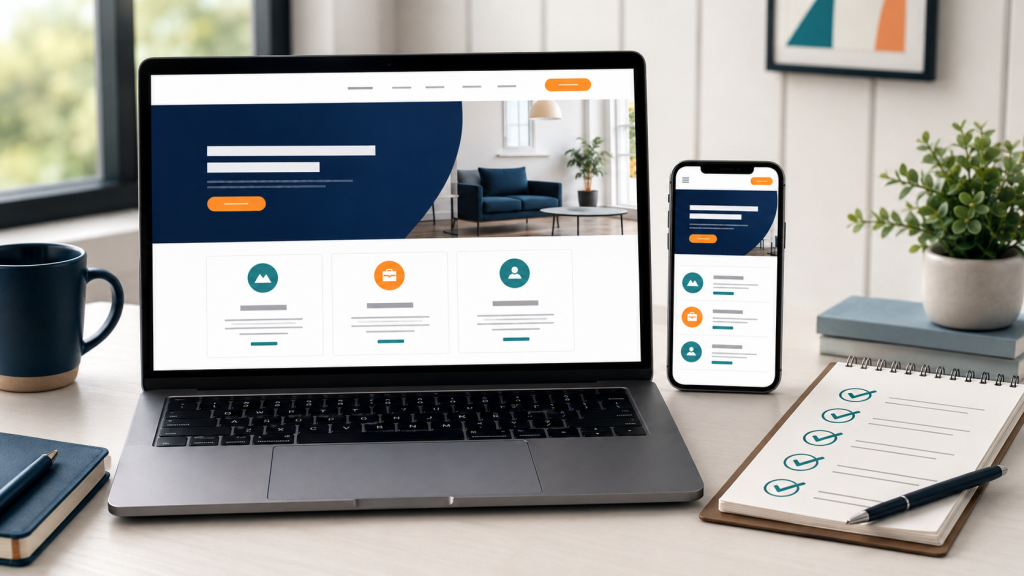
A small business website does not need dozens of pages or complicated features. It needs to explain what the business does, show why it can be trusted and give the right customer a clear way to make contact.
Quick answer
A practical small business website normally needs a clear home page, useful service pages, basic business information, a contact or enquiry route, a mobile-friendly layout, suitable privacy information and a technically reliable setup.
Everything else should be added only when it supports a real business requirement.
A small business website needs a clear purpose
Before deciding on colours, animations or a website platform, the business should be able to answer one question:
What should a useful visitor do after viewing this website?
Depending on the business, the answer might be:
- Send an enquiry
- Request a quotation
- Book a service
- Visit a local business
- Buy a product
- Read enough information to make a decision later
A website without a clear purpose often becomes a collection of pages that look acceptable but do not help the customer take the next step.
1. A home page that quickly explains the business
The home page should make the main offer understandable without forcing the visitor to search through the entire website.
A useful home page should normally explain:
- What the business provides
- Who the service or product is for
- Where the business operates, when location matters
- Why the visitor should trust the business
- What the visitor should do next
A vague headline such as “Welcome to our website” uses the most important part of the page without explaining anything useful. A specific description of the service is normally more helpful.
2. Separate pages for important services
A business with several distinct services should not hide all of them inside one long paragraph on the home page.
Separate service pages make it easier for visitors to understand what is offered. They also give search engines a clearer page to associate with a specific customer question.
A useful service page can include:
- A clear description of the service
- Who the service is suitable for
- What is included
- Important exclusions or boundaries
- The usual process
- A clear contact or enquiry option
This is particularly important when services have different audiences, processes or prices.
3. Trust information
A visitor may find a business through Google without knowing anything about it beforehand. The website must provide enough information for that visitor to decide whether the business appears legitimate and suitable.
Useful trust information may include:
- A clear About page
- The real business or operator name
- Location or service area
- Relevant experience
- Real photographs supplied by the business
- Customer reviews or examples of previous work
- Clear contact information
- Appropriate business and privacy information
Trust does not come from adding large claims such as “the best service”. Specific, verifiable information is usually more useful.
4. A simple contact or enquiry route
Once a visitor decides to make contact, the process should be obvious.
A small business website should normally provide at least one clear contact route. This may be an email address, an enquiry form or a booking system, depending on how the business works.
A useful enquiry form should:
- Ask only for information needed to handle the enquiry
- Explain what happens after submission
- Use spam protection
- Include an appropriate privacy agreement
- Send submissions to a monitored business email address
Too many unnecessary fields can make the form feel like an application process instead of a simple enquiry.
5. A mobile-friendly layout
A website should work on a phone without tiny text, horizontal scrolling or buttons that are difficult to press.
Mobile checks should include:
- Readable text sizes
- Clear navigation
- Buttons that are easy to select
- Forms that fit the screen
- Images that resize correctly
- Reasonable loading performance
A desktop design that merely becomes smaller is not automatically a useful mobile website.
6. Basic search and page structure
Basic SEO starts with clarity rather than tricks. Each important page should have a clear subject and should answer the questions a suitable customer is likely to ask.
A basic website setup should normally include:
- One clear main heading per page
- Descriptive page titles
- Useful meta descriptions
- Logical page addresses
- Internal links between related pages
- Image alternative text where appropriate
- An XML sitemap
- Connection to Google Search Console when required
These steps do not guarantee a particular Google position. They give search engines a clearer and more technically usable website to evaluate.
7. Suitable domain, hosting and business email
The business should control its own domain and hosting accounts. This prevents the website from becoming unnecessarily dependent on a designer or agency.
A business email address using the business domain can also look more established than relying entirely on a free personal email account.
Domain registration, hosting and email are recurring services. Their costs and renewal responsibilities should be clear before a website project begins.
8. Privacy, security and maintenance basics
A website is not finished permanently on launch day. Software, forms, plugins and business information may need attention later.
The initial setup should consider:
- HTTPS
- Secure administrator access
- Backups appropriate to the website
- Spam protection on public forms
- Privacy information relevant to the website
- A plan for software and content updates
The customer should also understand what support is included after launch and what future maintenance or changes will cost.
Should the website use HTML, WordPress or WooCommerce?
The correct platform depends on the website rather than on which system is currently popular.
HTML
Suitable for a smaller, fast website that does not need frequent customer-managed changes or an online shop.
WordPress
Suitable for editable business pages, articles, service information and websites that may need to expand later.
WooCommerce
Suitable when products or services must be sold online with a basket, checkout and payment process.
Using WooCommerce for a website that does not need online selling adds unnecessary complexity. Using a small static website for a business that needs frequent updates may create different limitations.
What does a small business website not need?
A starter website does not automatically need every feature that may be useful later.
Features that should be added only for a real reason
- Complex animations
- Dozens of mostly empty pages
- An online shop when no online selling is planned
- Multiple premium plugins with overlapping functions
- A customer account system that nobody needs
- A blog without a realistic publishing plan
- Integrations that create more maintenance than value
Starting with a clear, smaller website is often better than building a large system based on features the business may never use.
How much does a small business website need to include?
There is no single page count that fits every small business.
A sole trader with one clearly defined service may need only a few strong pages. A business with several service areas, workshops, products or locations may need a larger structure.
The appropriate scope should be based on the information customers need, the actions they should take and the amount of content the business can realistically supply and maintain.
Small business website self-check
Before requesting a website proposal, check whether you can answer these questions:
Business
- What does the business provide?
- Who is the ideal customer?
- What service area matters?
Content
- Which pages are required?
- Are the text and images ready?
- Who approves the final content?
Function
- How should customers make contact?
- Is online selling required?
- Who maintains the website later?
Clear answers make it easier to define the project, select the right platform and prepare an accurate quotation.
Need a practical small business website?
OTTA creates project-based HTML, WordPress and WooCommerce websites for small businesses and independent service providers. Each project is reviewed individually before a written proposal is prepared.
If you already have a website and only need a structured improvement review, the Small Website Improvement Review remains available separately.
Find our advice useful?
Add OTTA as a preferred source on Google.